Delivery
From stores, dark stores, pickup points and hubs to the customer’s door.
$1.96BGlobal autonomous delivery market · 2025 estimateRovers for delivery and patrol. Fleet OS to manage our robots and third-party fleets.
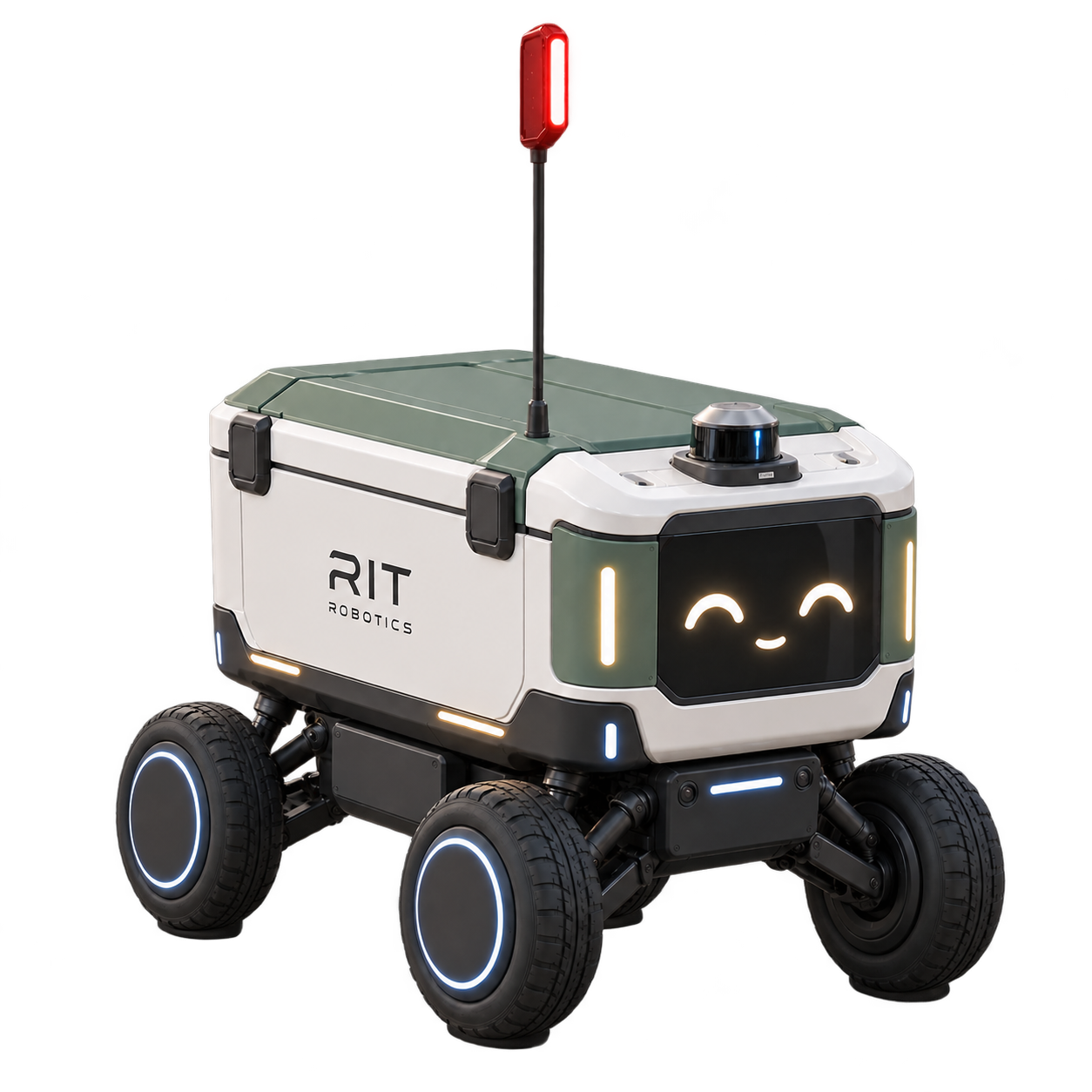
Sensors help the rover navigate, suspension smooths the ride, and the display helps it interact with people. Select a detail to discover its role.
Visual concept · equipment and placement are subject to refinement
From stores, dark stores, pickup points and hubs to the customer’s door.
$1.96BGlobal autonomous delivery market · 2025 estimateScheduled routes with photos and video sent to security staff. People decide how to respond.
$3.50BGlobal security robot market · 2025 estimateManage RIT and third-party fleets. Connect through API / SDK, in the cloud or on the customer’s servers.
$1.58BGlobal AMR/AGV fleet software market · 2025 estimateEstimates in RIT pitch deck v10: Grand View Research — delivery; Mordor Intelligence — security robots; MarketsandMarkets — AMR/AGV fleet software. The categories overlap and are not added together.
Target workflow: site map → autonomous route → photos and video to security → return to charge. Start with one shopping-centre floor, then expand to car parks, warehouses and controlled-access sites.
Automatic charging, sensors and integrations with doors, lifts and CCTV must be validated in each site pilot.Delivery is the platform’s first use case
reduction in last-mile delivery costs
RIT estimate. To be validated in the commercial pilot.From task to result: integration with client systems, fleet management and an activity log. Customers are not tied to a single robot manufacturer.
Orders · security systems · external services
Integration for clients and robotic platforms
Tasks · routes · remote operation · analytics
In the cloud or on the customer’s infrastructure
Delivery and patrol
Connected via API / SDK
RIT Rover + Fleet OS + API / SDK + Ritbit = one infrastructure for robot fleets
A delivery or a scheduled patrol
The client's system sends the data
The platform selects a rover and route
The robot carries out the task
Data returns to Fleet OS
Completion is recorded in the log
LiDAR and cameras assess free space. Onboard software plans a way around obstacles while Fleet OS monitors the task.
The environment changes.Two rovers currently drive autonomously by day and night on a closed test site. City operation is the next commercial pilot milestone.
Outcome
Fewer interventions per task let a team support more robots. That matters for delivery and patrol alike.
2 rovers on a closed test site
Paid deliveries and economic validation
The first paying platform customer
Different robots, tasks and sites
Our own rovers. An independent platform. One approach to management and audit.
Explore the rover mini-game